
Gut Feelings vs. Good Decisions: A Friendly Guide to Quantifying Choices
We’ve all had those moments—standing at a crossroads, trying to make a big decision, and hoping our “gut feeling” will steer us right. But let’s be honest: while intuition has its place, it’s often unreliable—especially when we’re dealing with complex decisions full of moving parts.
That’s where quantifying decisions comes in. Think of it as giving your choices a logical backbone—one that can help you cut through uncertainty, bias, and guesswork.
Let’s walk through why and how using numbers and structured thinking can actually lead to better decisions.
🎯 Why Not Just Trust Your Gut?
Our brains are amazing, but they’re also wired to take shortcuts. This can lead to cognitive biases—little mental traps that skew our judgment without us realizing it. For example:
- Overconfidence bias makes us think we know more than we do.
- We might favor our personal experience over hard facts.
- Sometimes we even make decisions just because “they feel right.”
While gut feelings can help in simple, familiar situations, they can fall short when things get complicated. So how do we make smarter decisions?
🔢 Tools to Make Better Choices
1. Decision-Making Matrix
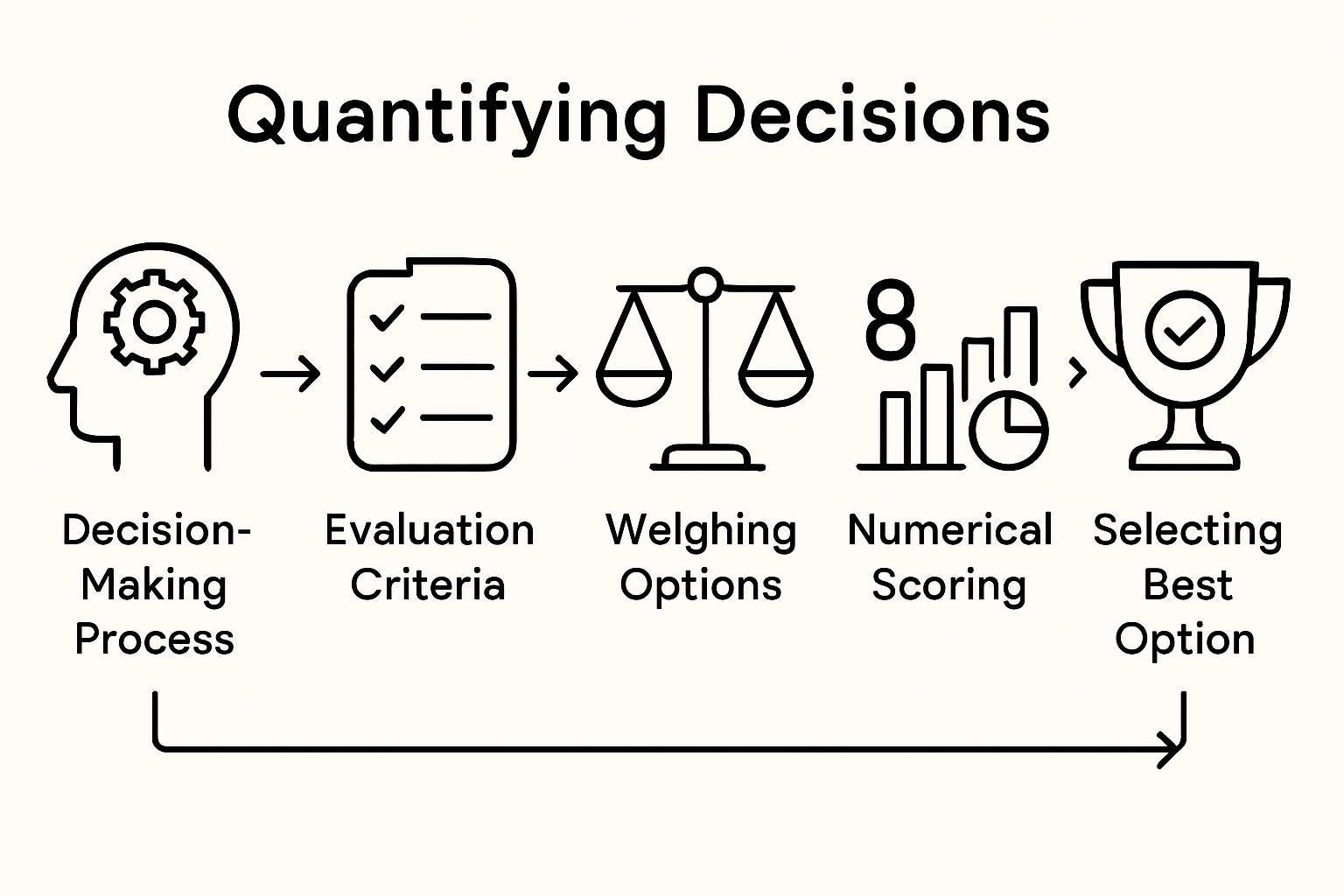
This is like a scorecard for your choices. Here’s how it works:
- List your options.
- Decide what criteria matter most (cost, time, quality, etc.).
- Assign each criterion a weight based on importance.
- Score each option against each criterion.
- Multiply and total up the scores.
✔ Best for: Comparing multiple options with lots of variables (e.g., buying a car, hiring a new employee).
2. Expected Monetary Value (EMV)
If money is part of the equation, EMV can help:
- Consider all possible outcomes of a decision.
- Estimate how likely each outcome is.
- Multiply the value of each outcome by its probability.
- Add them all up to see which option is the most financially sound.
✔ Best for: Business decisions, investments, or any scenario involving risk and reward.
3. Decision Trees
These are visual tools that lay out decisions and their consequences in a tree-like format. They’re great for:
- Mapping out multi-step decisions.
- Understanding the ripple effects of each choice.
- Visualizing uncertainty and outcomes clearly.
✔ Best for: Strategic planning, product launches, or any decision with multiple stages and outcomes.
🧠 The Science Says It Works
Studies and real-world success stories back it up:
- According to Statista, businesses using data-driven methods are 35% more likely to accurately predict market trends.
- In healthcare, research shows that evidence-based decisions reduce errors and improve patient outcomes.
- The book “Moneyball” tells the story of how the Oakland A’s used statistics—rather than scout intuition—to build a competitive baseball team on a tight budget. The result? They outperformed much richer teams by simply relying on smart data.
⚖️ Avoiding Pitfalls: Don’t Let the Numbers Blind You
Using data is powerful, but it’s not foolproof.
🔍 A study published in PNAS warns about “quantification fixation”—getting so obsessed with numbers that we ignore important non-numeric factors (like team chemistry or customer satisfaction).
The takeaway? Balance is key. Use numbers to guide your thinking, but don’t forget to consider the full picture.
🧭 Bottom Line: Structure Beats Guesswork
Quantifying your decisions won’t guarantee success every time—but it does give you a clearer, more rational path forward.
By combining:
- solid tools like matrices, EMV, and decision trees,
- an awareness of cognitive biases,
- and real-world data,
…you’re setting yourself up to make smarter, more confident choices.
So the next time you’re facing a tough call, don’t just go with your gut—put some numbers behind it.
✅ Friendly Tip: Start small! Try a decision matrix the next time you’re choosing between job offers, vacation spots, or big purchases. It’s easy to use—and surprisingly eye-opening.




Leave a Reply